# Bulk Testing Docker Agent Performance Across 18 Codebases
> Using CLI tooling to bulk run testing pipelines across 18 different codebases.
Antoine Frau · 2025-12-15 · https://kerno.io/blog/cli-apt-for-docker-compose-agent/
## Introduction:
In a [recent post](/blog/cli-tooling-for-agent-testing-pipelines), I showcased the CLI tooling we’ve built to enable **scalable, repeatable agent testing** across a wide range of environments. This tooling allows us to stress-test agents under varied real-world conditions and compare performance consistently.
In this post, I’ll outline how we used that CLI to evaluate our **Docker Compose Agent** across **18 different codebases**, and what we learned from the results.
## **Methodology**
While I won’t go into the details of our proprietary scoring model, the high-level process was straightforward:
1. We ran the Docker Compose Agent across **18 distinct codebases**
2. The full test run took **~8 hours**
3. Results were **manually annotated** to validate correctness and outcomes
4. We used **Cursor** to visualize and analyze performance trends
This approach allowed us to assess success rates, failure modes, and runtime behavior across a representative sample of production-like setups.
## **Codebase Composition**
### **By Framework**
- NestJS
- Django
- FastAPI
- Express.js
- Koa
- Flask
- Next.js
#### **By Runtime**
- Python
- Node.js
- Bun
#### **By Language**
- Primarily **Python** and **TypeScript**
#### **External Dependencies**
Many of the tested codebases relied on real infrastructure dependencies, including:
- PostgreSQL
- SQLite
- MongoDB
- ClickHouse
- Couchbase
- MariaDB
- and others
This ensured the agent was evaluated against **realistic Docker Compose setups**, not synthetic examples.
Check out the video below.
## The Results:
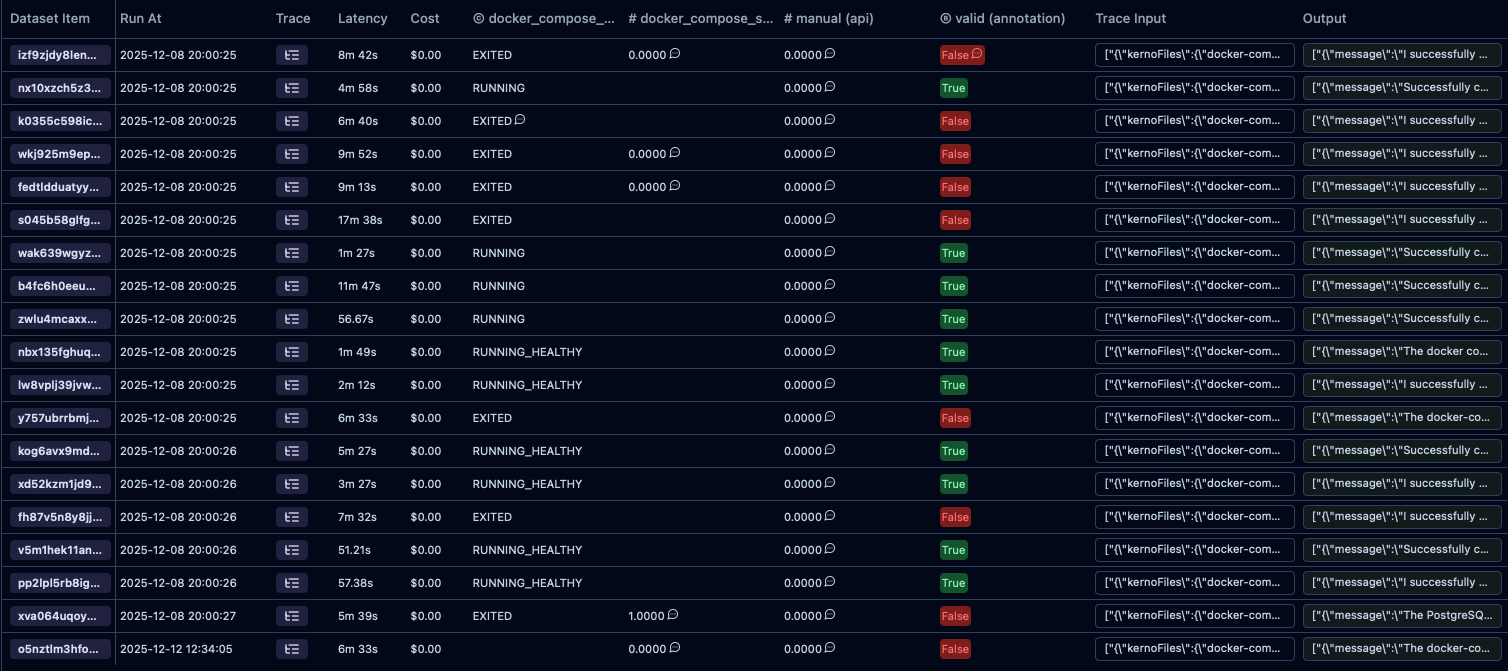
Across 19 runs, Docker Compose Agent runs 50% of the time.
### **Success vs Failure**
- **Majority of runs succeed**
- Successful states are RUNNING and RUNNING\_HEALTHY
- RUNNING\_HEALTHY is the dominant steady state
- **Failures are clean and binary**
- All failures end in EXITED
- Failures consistently have valid=false
- **No gray states**
- No partial, degraded, or ambiguous outcomes
### **Latency**
- **Successful runs**
- Fastest: ~50s–2m
- Typical: ~3–7m
- Long tail: ~9–12m+
- **Failed runs**
- Can fail early or late (up to ~17m)
- Latency is **not predictive of success**
**Takeaway:** Longer runtime does not increase success probability; failures are not timeout-driven.
Summary of results
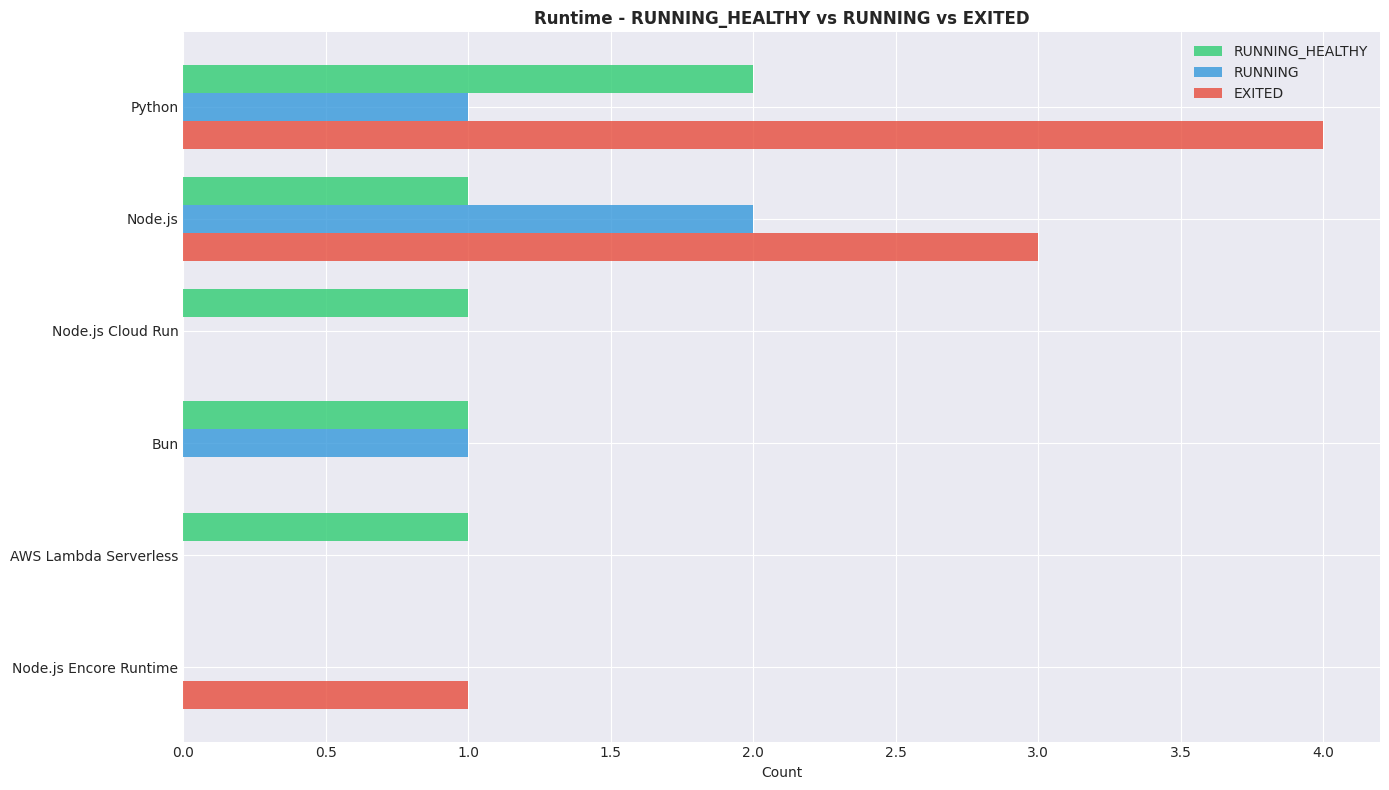
### **Runtime**
- **Docker-based runtimes (Python, Node.js) have the highest exit rates.**
- **Managed runtimes (Cloud Run, Lambda) show only healthy outcomes.**
- **Bun performs cleanly with no exits.**
- **Encore runtime consistently exits → likely unsupported or misconfigured.**
Breakdown by Framework
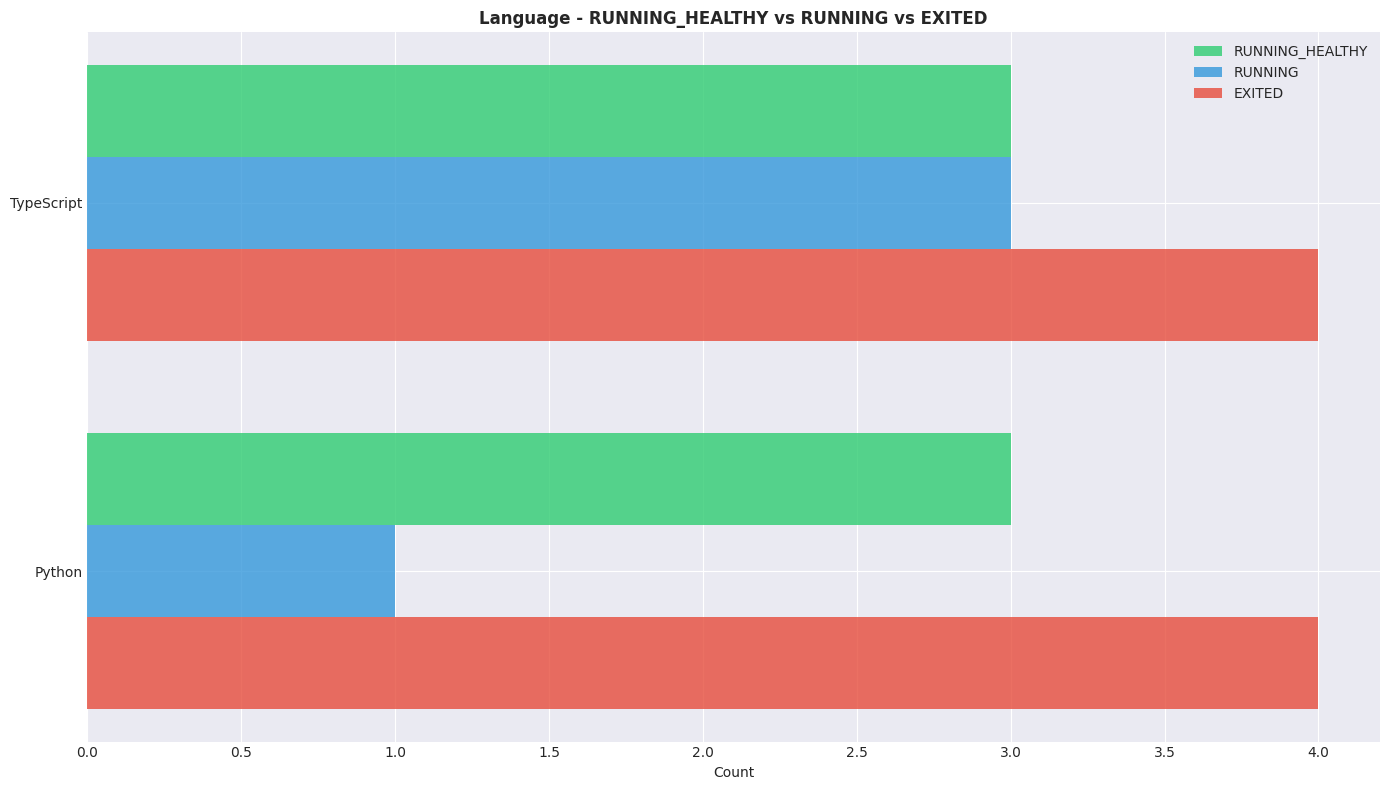
### **Language**
- **TypeScript has the strongest success profile despite higher volume.**
- **Python shows disproportionately more exits relative to successes.**
Breakdown by language
## Conclusion
The current 50:50 success:fail rate could be down the following
- **Docker File Dependency:** A key finding was that success rates are much higher when a Dockerfile is present in the repository, and the agent often fails or gives up when there is no Dockerfile.
- **LLM Behavior:** The LLM was observed to go into loops, spending a long time trying to fix or build a Docker image, especially when no Dockerfile exists.
## **Next steps:**
- More tests and increased logging
- **Proposed Solution:** The developer suggested splitting the Docker Compose agent's role, with a separate agent dedicated to creating a valid Dockerfile, to improve the overall performance of Docker Compose generation.
- **Context Missing:** The LLM was noted to be missing a lot of context, and there is suspicion that it may not be correctly accessing existing Dockerfiles and Docker Compose files.