
News
Introducing Kerno v1, the AI runtime QA engineer for your backend
Kerno v1 tests your user flows, APIs, MCP servers and queues against your real stack from inside Claude Code, Cursor or Codex, and catches bugs before they merge.
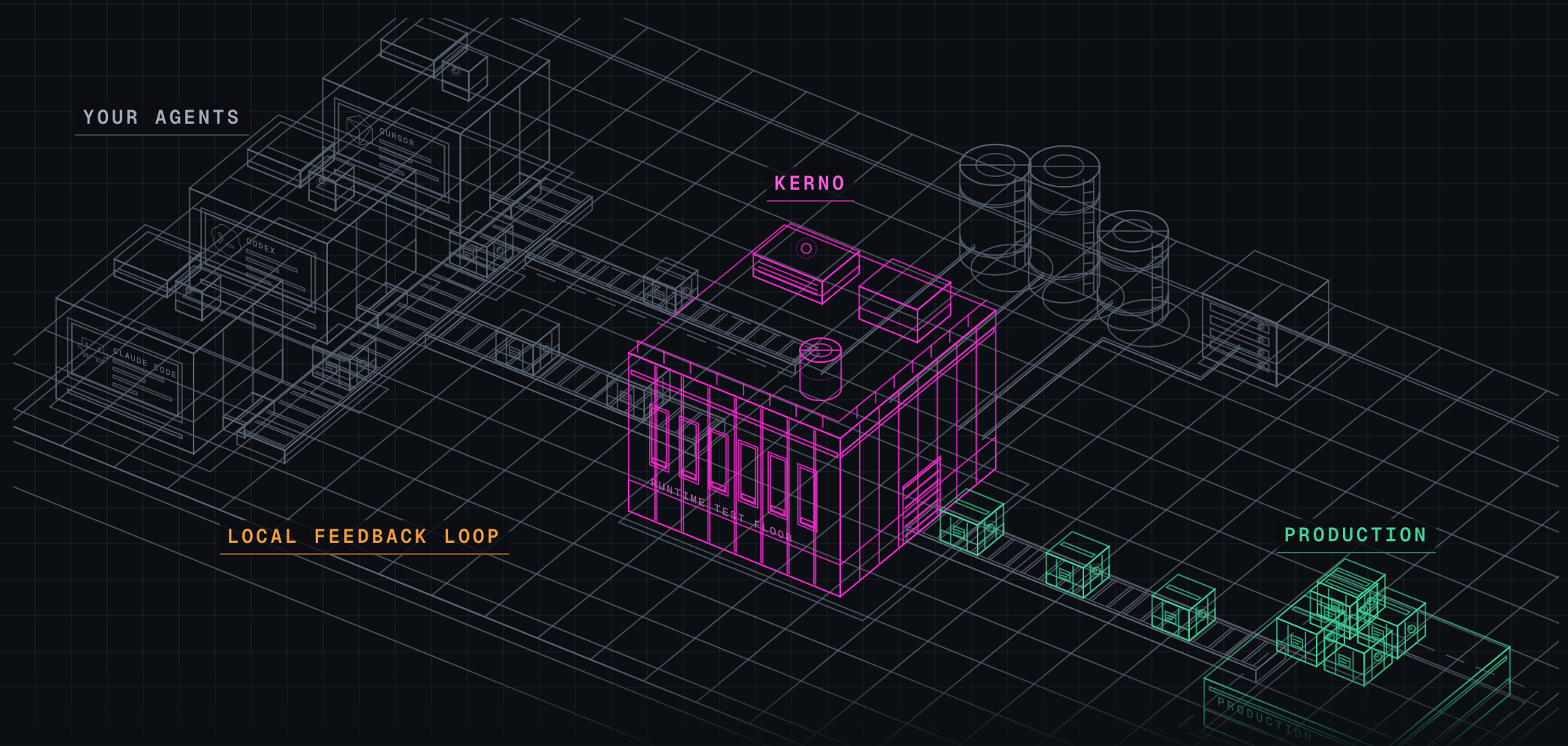
Big news! Kerno v1 is out, and it’s our biggest upgrade so far.
Kerno is an AI runtime QA engineer for backend code, built to verify and secure everything your agents ship. It works inside Claude Code, Cursor, Codex and any coding agent that speaks MCP, tests your critical user flows against your real databases, queues and services, and catches runtime and security bugs before they merge. Kerno v1 is our most advanced release yet, and it brings a brand-new Portal that shows your whole team where every application stands.
You can try it free today.
Over the past few months, we’ve run Kerno with startups and unicorns, on everything from brand-new codebases to backends more than 10 years old. Here’s what teams are seeing.
The problem we’re solving
Writing code is fast now. Proving it works at runtime is the bottleneck.
Coding agents produce endpoints, migrations and queue consumers in minutes. Code review reads the diff, and unit tests run against mocks. Neither one exercises the change against a real database, a real queue or a real login. So most teams find out what a change really does hours later in CI, or worse, in production. By then the slop has piled up, eating engineering time, forcing expensive rework and slowing every release.
We built Kerno to close that loop where the code is written. Every time your agent touches your backend, Kerno verifies your critical flows against your real stack and hands the evidence straight back to the agent.
How Kerno v1 works
Kerno runs in four steps, and your agent drives all of them in plain language.
- Map. Kerno indexes your repo and finds every entry point, from HTTP routes and MCP tools to background jobs and queue consumers. It connects to your running app, learns how to sign in and seed data, and maps your critical user flows with you.
- Test. Kerno plans tests for each flow and entry point and shows you the plan first. Once you approve, it writes the tests, runs them against your real services, and saves them to your repo as a baseline of how your backend behaves today.
- Verify. When code changes, Kerno traces the change through your call graph to every entry point and flow it reaches, re-runs those tests, and shows exactly where behaviour moved.
- Evolve. When a change is intentional, you accept it and Kerno updates the tests, so your suite keeps up with your product.
Here’s what that sounds like in practice:
Map the key user flows in this app with Kerno.Use Kerno to test the checkout flow.Use Kerno to validate the entry points and flows my changes affected.What’s in v1
This release brings a ton of new features.
Critical user flows
Ask your agent to test a full journey, like signing up, creating a project and inviting a teammate. Kerno walks every step in order and checks the end result. After a change, it re-runs every flow the change touched, so a broken journey gets caught even when each endpoint still passes alone. How user flows work
Learning
Kerno figures out how you sign in, set up test data and run your environment. It remembers what worked in your repo, shares it with your whole team, and gets sharper with every run. You can review each lesson it keeps and agree, amend or reject it. How Kerno learns
Custom rules
Set your team's conventions and priorities once, and every test Kerno writes follows them. Rules live in your repo, so the whole team inherits them. Try Add a Kerno rule for POST /api/users: a duplicate email should return 409. Custom rules guide
Security testing
Kerno checks each entry point against the OWASP API and Web Top 10 categories that apply to it, such as broken access control, injection and excessive data exposure. A leaked field or stack trace fails the test, with the evidence attached. Security testing
Background jobs and queues
Celery, Kafka, RabbitMQ, SQS, Azure Service Bus and Graphile Worker, tested on real workers. Kerno queues real work and checks what your consumer actually did, like the rows it wrote or the messages it sent on. Async and worker testing
MCP servers
Every tool your MCP server exposes gets tested at runtime, including the tools behind auth and the ones your server only registers once it starts. MCP testing
AWS serverless
Kerno reads your SAM templates and Serverless Framework configs to find your routes and SQS-triggered Lambdas, and tests them with DynamoDB and Cognito in the loop. Supported technologies
CI on every PR
Your tests live in your repo, and our GitHub Action re-runs them on every pull request. The check is fully deterministic, so the same code always gets the same verdict, and results come back as JUnit. CI integration
The new Kerno Portal
Your agent gives each engineer the answer in the moment. The Portal gives the whole team the big picture. We rebuilt it from the ground up for v1.
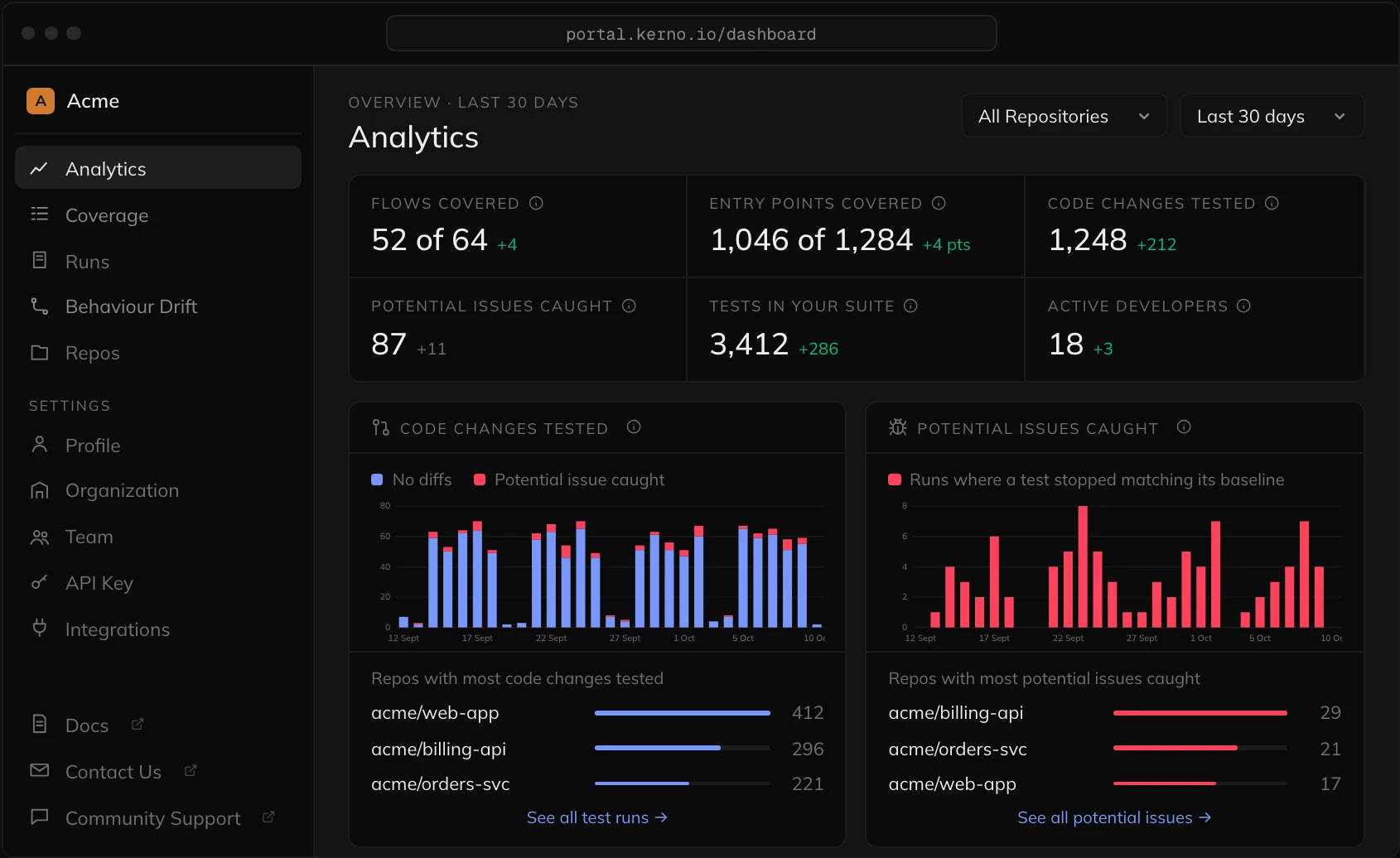
Analytics
One view of how Kerno is working across your organization. Flows covered, entry points covered, code changes tested, potential issues caught, the size of your test suite and active developers, with trends over time and the repos that need attention most.
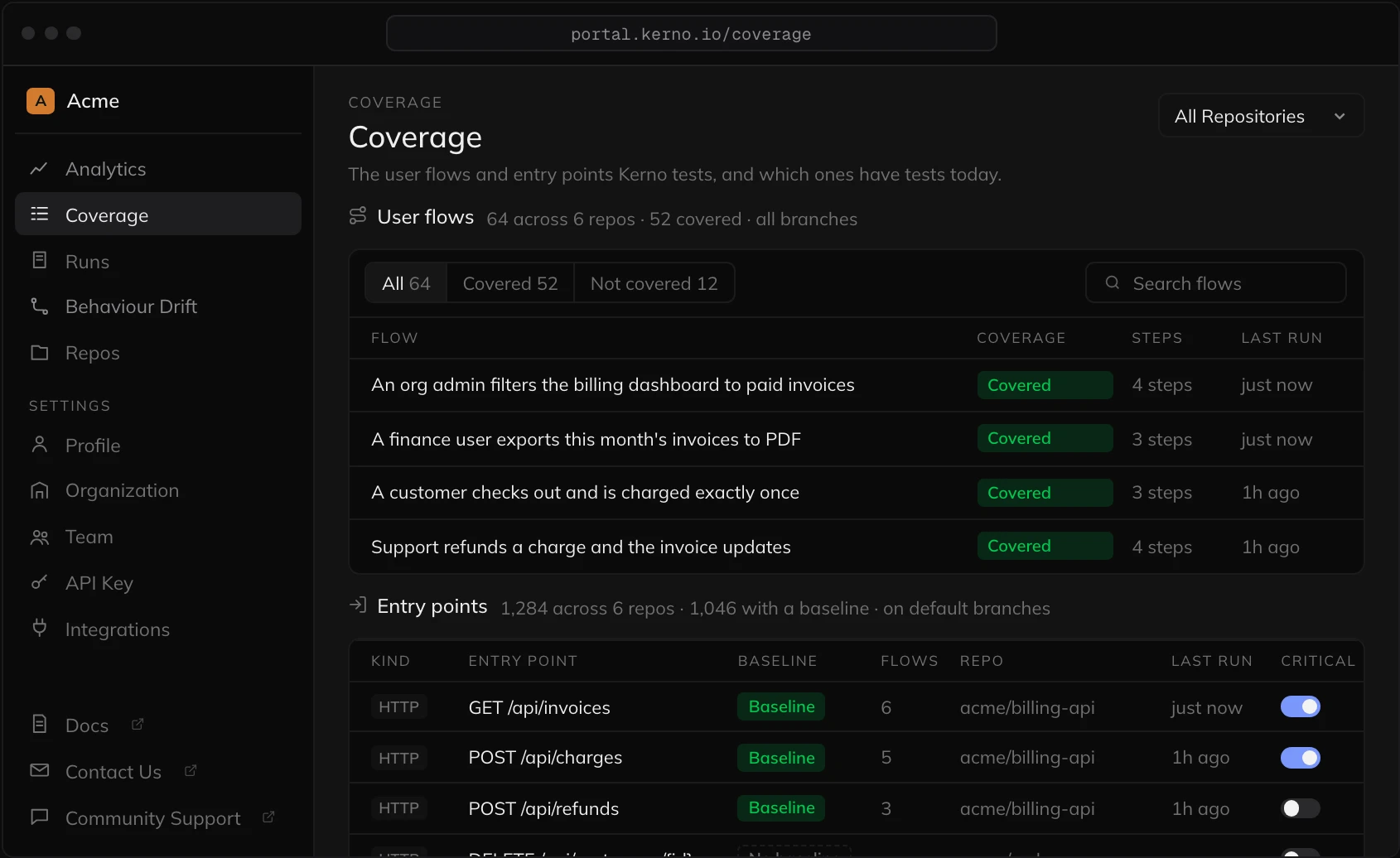
Coverage
Every user flow and entry point Kerno knows about, with what’s tested and what isn’t yet. Mark the entry points that matter most as critical and filter straight to them.
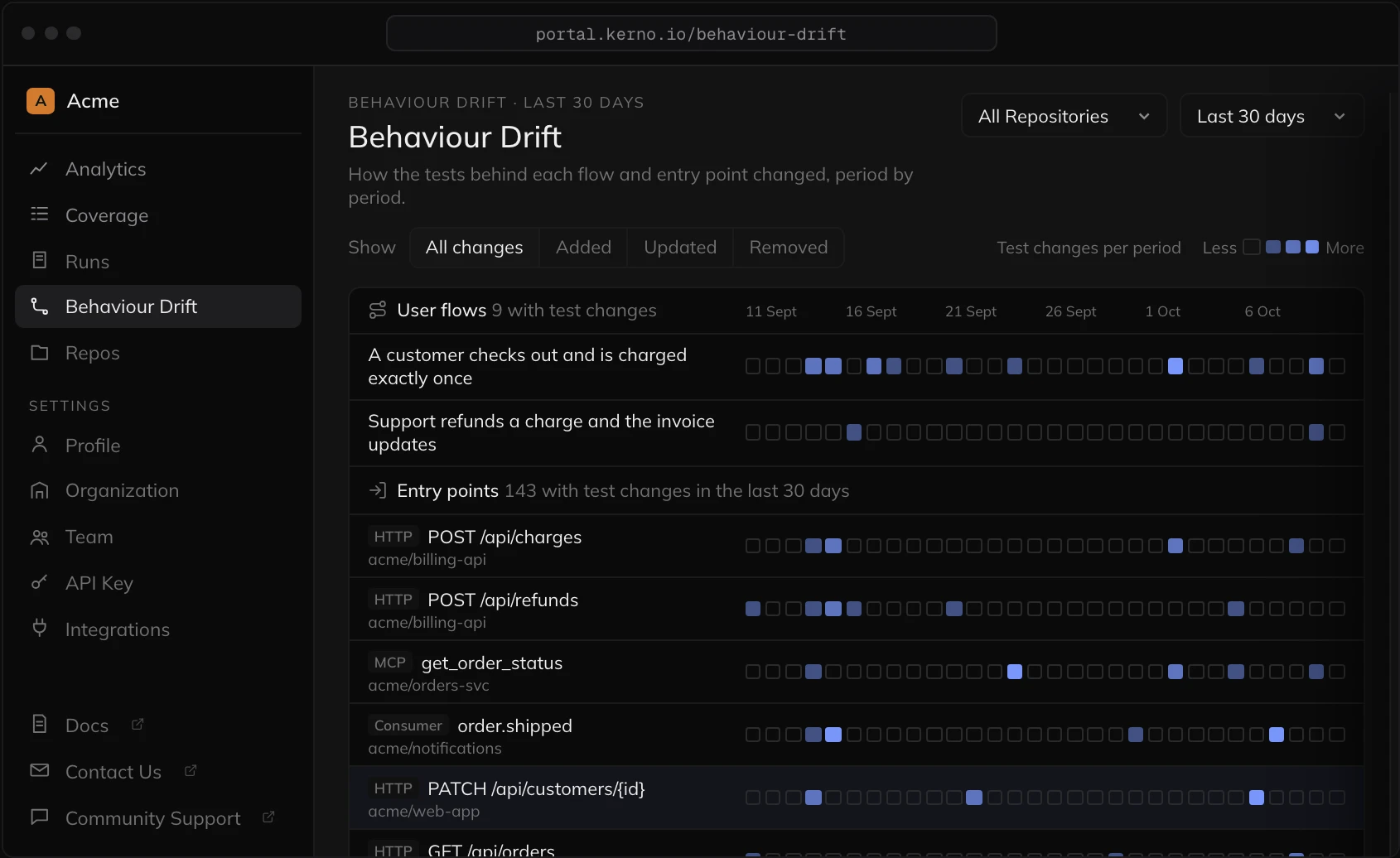
Behaviour Drift
A heatmap of how the tests behind each flow and entry point changed day by day, so you can spot the parts of your product that move the most and open the changes behind any day.
And more
- Guided setup. Five live steps take you from install to your first user flows. Kerno connects, indexes your codebase, connects to your environment, saves its calibration and detects your flows, and the Portal updates as each step completes.
- Runs and run reports. Every run from every engineer, filterable by repo, branch and author. Open one and you see each test in plain English, the request and response evidence, and Kerno’s own before-and-after comparison for every check that changed.
- Repos. Each repository’s coverage and drift in one place, filterable by branch.
- CI in one file. The Integrations page hands you a ready-made GitHub workflow that runs your Kerno tests on every pull request.
Faster and smarter under the hood
v1 also makes everything around those features quicker and more reliable.
- Finds more of your backend. Kerno reads routes, jobs and queue consumers straight from your code first, which makes the first scan faster and more predictable. If a route is mounted somewhere unusual, ask for it by name and Kerno tracks down the handler.
- Maps your flows right after setup, so you see your critical journeys before the first test runs.
- Shares one code index across your team and CI. When one machine indexes your code, everyone else picks it up, and a fresh clone starts where the team left off.
- Draws your workspace as a live graph inside your coding agent, with your modules, endpoints, flows and dependencies lighting up as tests run.
- Guides your agent at every step. Every response tells the agent what to do next, so sessions keep moving.
- Reports only what a run actually observed. Every finding points to evidence you can check.
- Broader JVM support. Kerno understands your modules from their build files, for any JVM language and build tool.
What teams are saying
"Regressions have always been a huge bottleneck for our team. Kerno has been a force multiplier helping us ship releases much faster without the manual overhead of QA."
 Ronan HigginsCTO, Veritage
"Using Kerno with Claude Code has been a game changer. You get quick feedback with no manual effort, and it saves you a lot of time and hassle debugging integration issues post-merge."
 Jonathan BernalesCTO, Germen
"Kerno was up and running in minutes with no manual work, and it made our API migration so much smoother. We could instantly validate that every change made by Cursor worked the way we expected, and now it's a core part of how we build."
 Misch StrotzCo-Founder & CEO, LetzAI
"Kerno saves us a lot of manual work and helps us catch side effects and issues that would definitely break our projects' backends. Our engineering team loves it."
 Santiago J. VallsCo-Founder & CTO, Bewise
How to get started with Kerno v1
Setup is a one-time job of 30 to 60 minutes, depending on your project. You’ll finish with your first user flows covered.
- Create your free account. The Community plan covers one repo and needs no credit card.
- Follow the guided setup in the Portal. It gives you a setup prompt to paste into your coding agent. Your agent installs the CLI, connects Kerno, and analyzes your workspace, while the Portal shows each step as it completes. You’ll need Docker, Node.js 18+ and a git repository. The quickstart covers each step.
- Test your first flow. Pick the journeys that matter most, and ask your agent to test them.
- Add Kerno to CI. Drop one step into your GitHub workflow, and every pull request gets checked. The CI guide has the full workflow.
- uses: kernoio/kerno-check@v1
  with:
    sut-url: http://localhost:8080
Pick the service your team cares about most and see what Kerno finds.
Want a walkthrough first? Book time with our team. We’d love to hear what you’re building.
Frequently asked questions
What is Kerno?
Kerno is an AI runtime backend QA engineer. It works inside your coding agent, tests your critical user flows and entry points against your real stack, and catches runtime and security bugs before they merge.
What's new in Kerno v1?
Kerno v1 adds end-to-end user flow tests, a rebuilt Portal with Analytics, Coverage, Runs and Behaviour Drift, faster and more complete discovery of your backend, a code index shared across your team and CI, and a live graph of your workspace inside your coding agent.
Which coding agents does Kerno work with?
Kerno works with any coding agent that supports MCP, including Claude Code, Cursor and Codex.
Which languages and frameworks does Kerno support?
Kerno detects routes in TypeScript and JavaScript, Python, Java, Kotlin, Scala, Go, Ruby, PHP, C#, Rust and Swift, across frameworks such as Express, NestJS, Django, FastAPI, Spring, Rails, Laravel, Gin and ASP.NET. It also tests MCP servers, background jobs and queue consumers, and AWS serverless apps.
What does Kerno test?
Kerno tests HTTP endpoints, MCP tools, background jobs and queue consumers, and full user flows across several of them. Tests cover functional behaviour, edge cases and security checks based on the OWASP API and Web Top 10.
Where does Kerno run my tests?
Kerno runs your tests against your application running locally or in an environment you choose, with your real databases, queues and services. Your tests are saved in your repository, so you commit them alongside your code.
Does Kerno work in CI?
Yes. The Kerno GitHub Action re-runs the tests in your repository on every pull request and reports the results as JUnit. The check is deterministic, so the same code always gets the same verdict.
How long does it take to set up Kerno?
Setup is a one-time job of 30 to 60 minutes, depending on your project. The Portal guides you through each step, and you finish with your first user flows covered.
How much does Kerno cost?
Kerno is free to start. The Community plan covers one repo and one user with 30 test runs a month, with no credit card required. Pro is $50 per developer per month with unlimited runs, repos and users. Enterprise plans add SSO, self-hosting, audit logs and an SLA.
Try Kerno on your codebase
Kerno tests and verifies every backend change against your real app and dependencies, so your team catches runtime bugs before they ship.