
Understand and close the AI quality gap in your codebase.
Kerno Audit analyzes your codebase and its commits, and shows where quality slipped after your team adopted AI agents, in complexity, rework and test coverage. Close the gap, and your team saves tokens and engineering time on redoing work.
npm install -g @kerno/clikerno audit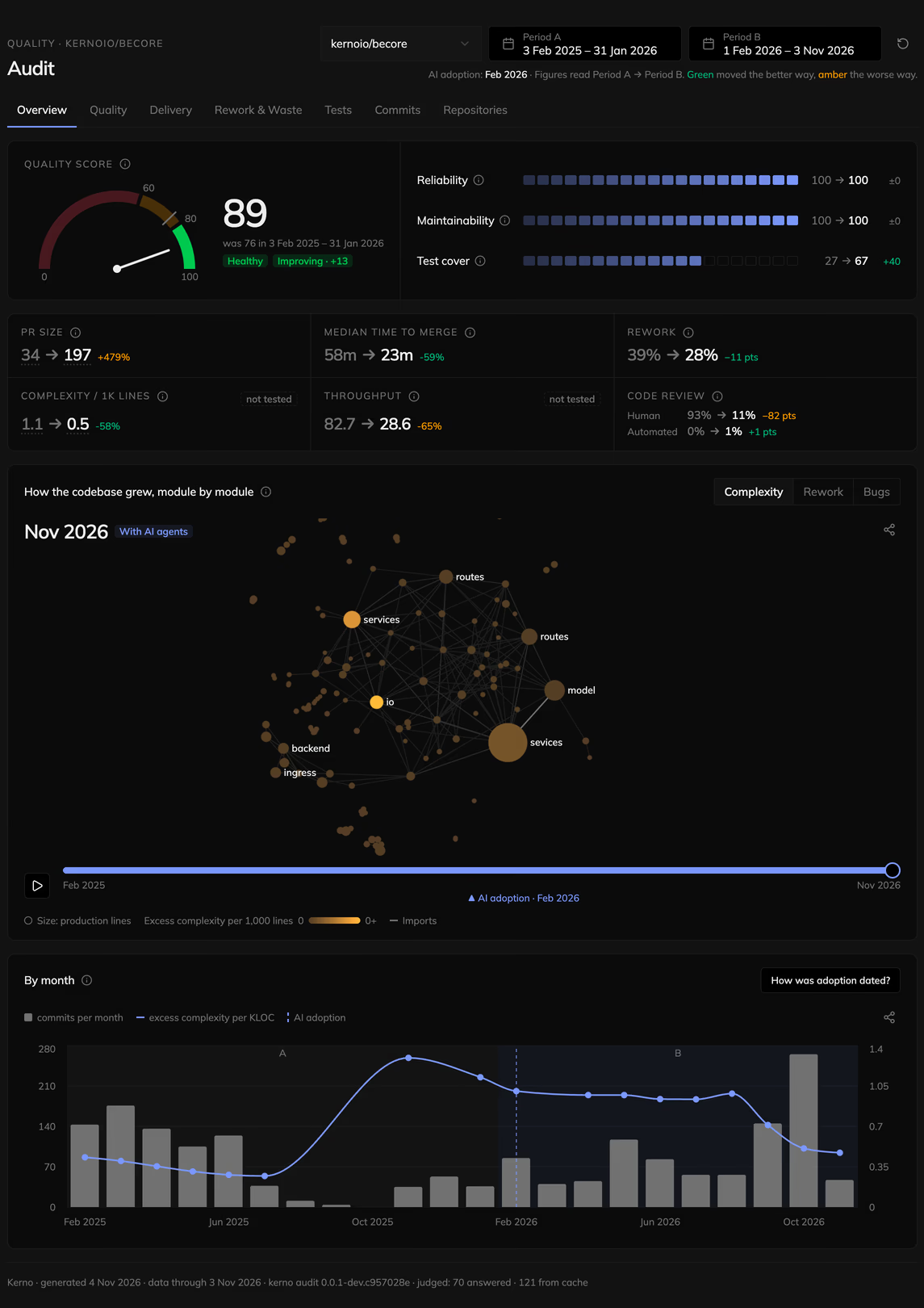
AI is helping developers ship more code, but it is also accelerating complexity that compounds fast. Left unchecked, that complexity will build up silently, in code that is becoming slower and riskier to change.
- +71%code shipped per engineer
Each engineer now owns more code.
Hall 05 · Delivery → - +50%complexity in new code
More paths to understand and test in every change.
Hall 03 · Complexity → - +43%follow-up changes on AI-written commits
AI commits are revisited more than other commits.
Hall 04 · Rework and waste → - 25%of commits are still bug fixes
Test changes nearly doubled, and bug fixes held at a quarter of commits.
Hall 02 · Untested hotspots →
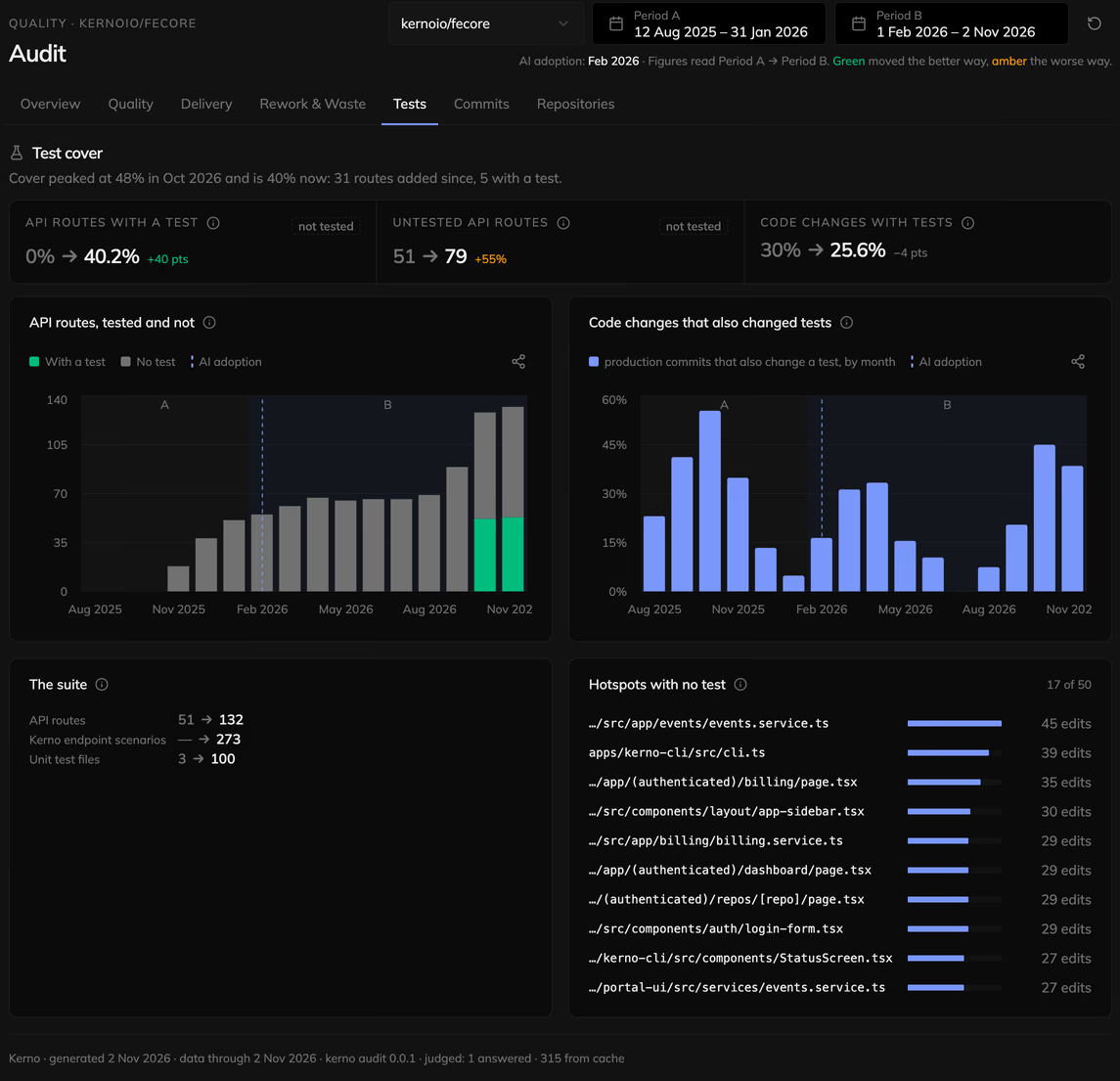
Close the test coverage gaps in your high-churn code, before they turn into regressions
See where the code your team changes most has no tests, and add them there before the next change breaks something.
- Gauge 01
Most-changed code with no tests
Your most edited functions and files that no test touches, ranked by edits.
- Gauge 02
API routes with no tests
Every API route in your code, split into tested and untested, month by month.
- Gauge 03
How often changes include tests
The share of production commits that also change a test, before and after your team adopted AI agents.
Catch rising complexity early, while it's still cheap to fix
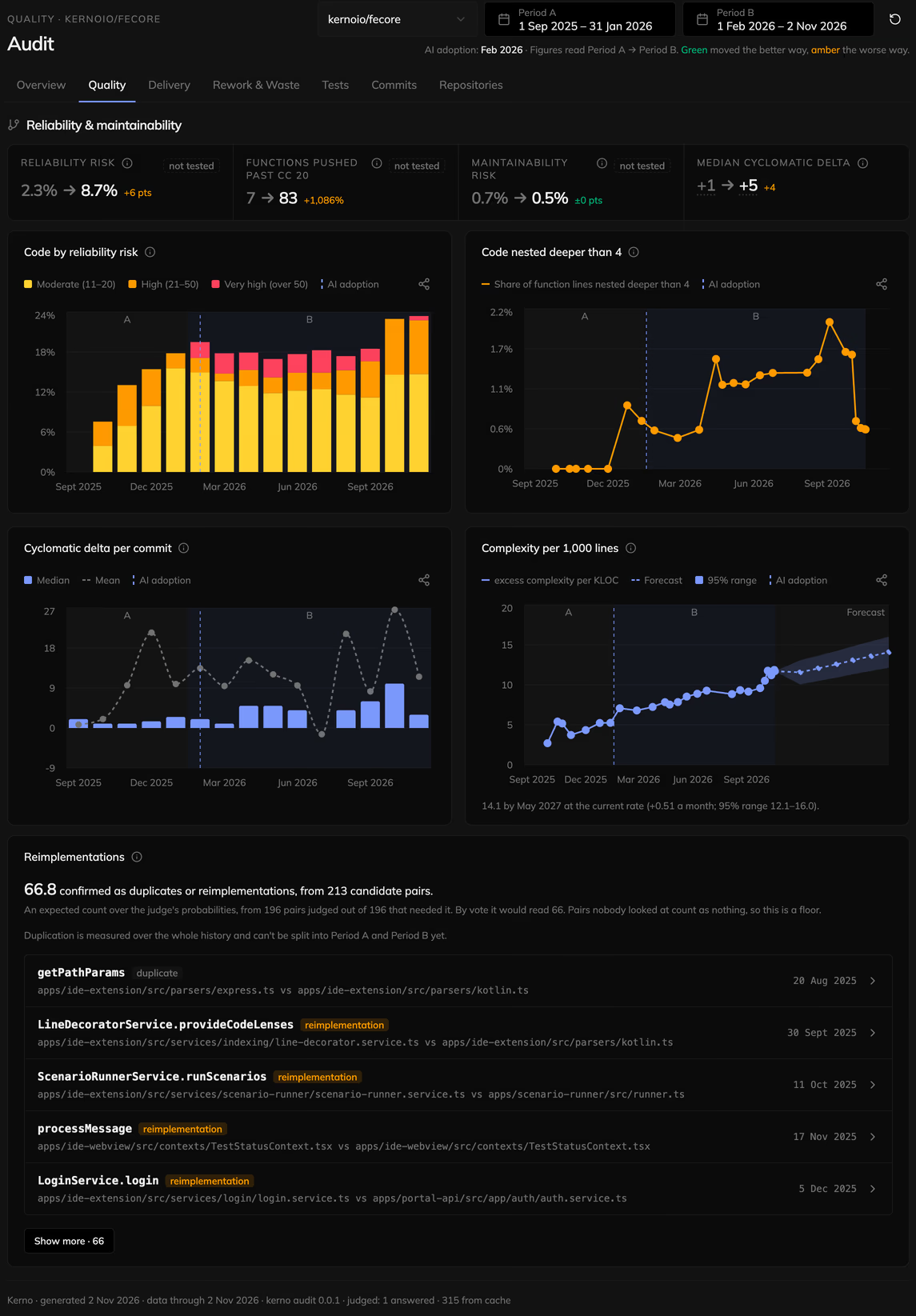
Every if, loop and case is another path to understand and test. See how fast your new code is adding them, and address it before they pile up.
- Gauge 01
Complexity added by new code
Cyclomatic complexity added per 100 new production lines, month by month, with your AI adoption month marked.
- Gauge 02
Functions that became too complex
Every function a commit pushed past cyclomatic complexity 20, with the commit that did it.
- Gauge 03
Where complexity is heading
Where complexity per 100 new lines is heading over the next 12 to 24 months on your current trend, with a 95% range.
Spot the code that keeps getting reworked, fix the cause, and save engineering time and tokens
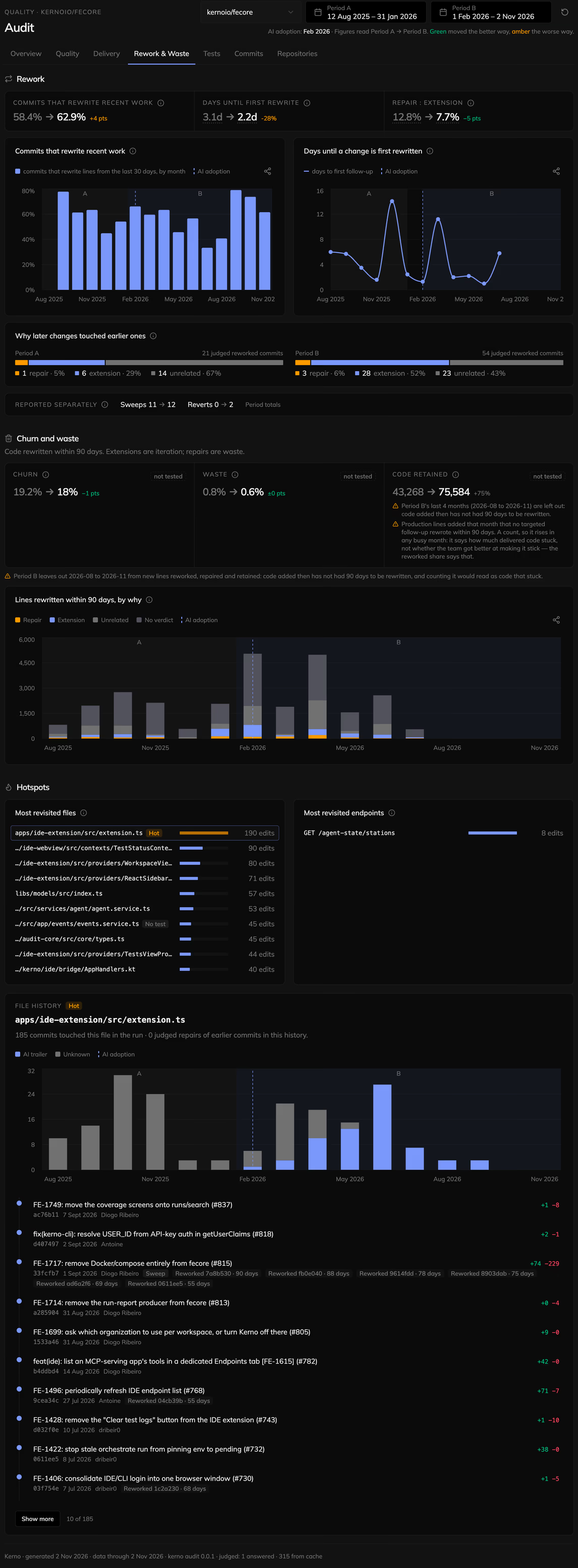
See where your team keeps redoing the same work, and whether it is fixing mistakes or building on earlier work. Fix the cause once, instead of paying for it again in engineering time and tokens.
- Gauge 01
The code reworked most
The functions, endpoints and files your team rewrites most, with how many edits came within 30 days of the previous one and how many came from agents.
- Gauge 02
Whether each rewrite was a fix
An AI model reads each rewrite and labels it a repair, which fixes the earlier change, or an extension, which builds on it.
- Gauge 03
Share of work spent on rework
The share of commits that rewrite code from the last 30 days, and how many days pass before a change is first rewritten.
Find out how much of your AI output is real progress, and how much is wasted time and money
See whether your team's extra AI output turns into progress, or into churn that keeps costing engineering time and tokens.
- Gauge 01
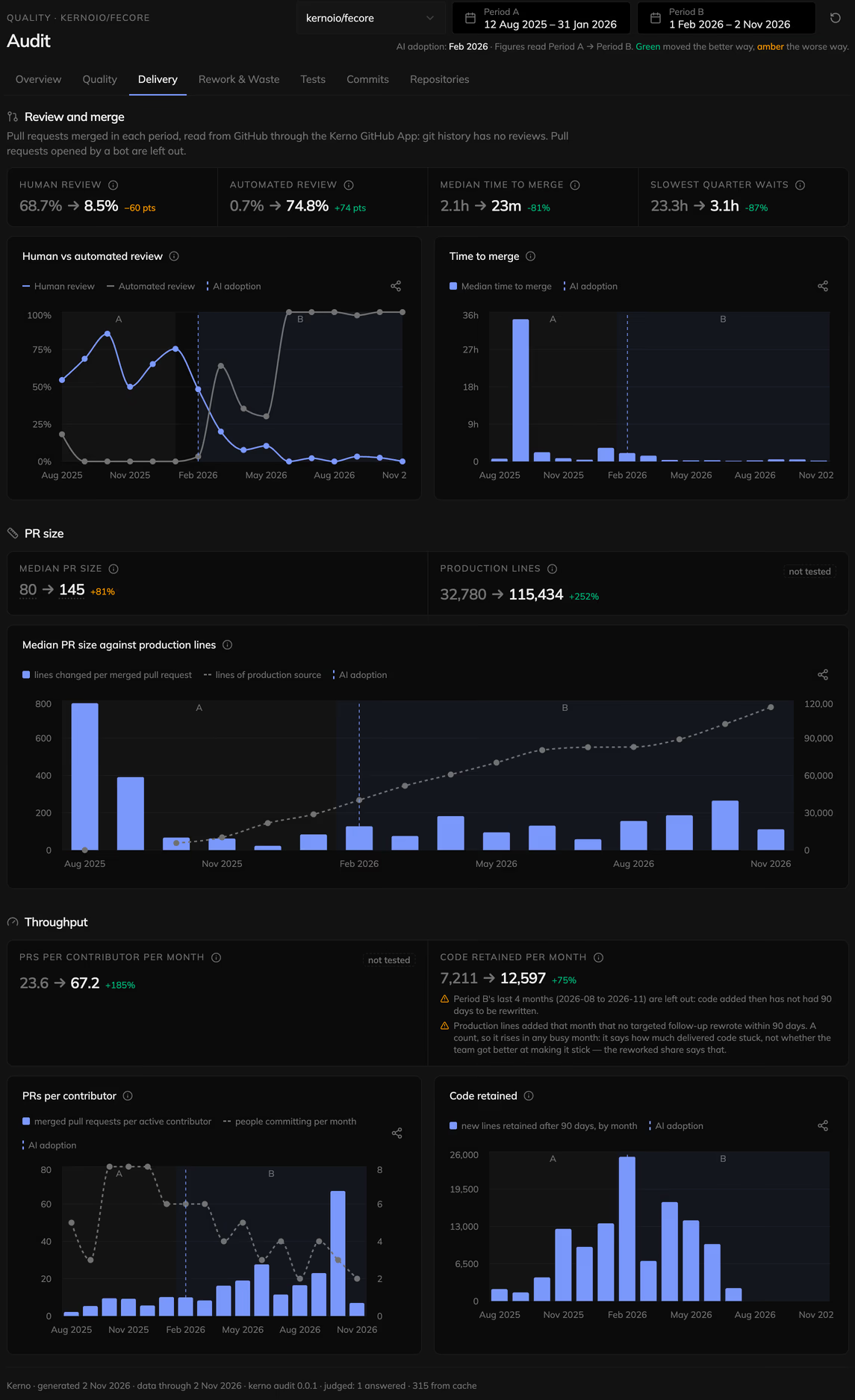
New code that stays in the codebase
The share of new lines nobody has rewritten or deleted 90 days later.
- Gauge 02
Pull requests merged per engineer
Merged pull requests per active author each month, before and after your team adopted AI agents.
- Gauge 03
How big pull requests have become
Lines in each merged pull request. Bigger changes are harder to review and riskier to merge.
Works with your codebase, your stack and your agents
 TypeScript
 JavaScript
 Python
 Go
 Java
 Kotlin
 Ruby
 PHP
 C#
 Rust
- Scala
- Swift
- C++
 C
- Dart
 Claude Code
 Cursor
 GitHub Copilot
 Codex
- Devin
- Jules
- Aider
- Windsurf
Audit your codebase in minutes
npm install -g @kerno/clikerno auditWork with our AI quality engineering experts to audit your codebase and close the quality gap
Kerno Audit shows where quality slipped after your team adopted AI agents. Our engineers work with your team to find out why, and what to fix first, so your team spends its time and tokens on the changes that matter most.
- Signal 01Detected
Quality is slipping in your codebase
Your agents ship more code than your team can track, and you need to know where to start.
- Signal 02Detected
Rework is eating your tokens and time
Your engineers and agents keep redoing the same code, and every round burns tokens and engineering time.
- Signal 03Detected
Quality is inconsistent across your team
Every engineer works with agents in their own way, so the quality of what they ship varies from person to person.
- Step 01
Deep codebase audit
We run Kerno Audit on your repositories, then our engineers dig into the code behind every hotspot.
- Step 02
Root-cause analysis
We work through the findings with your engineers to find why each problem keeps coming back.
- Step 03
A prioritized plan
What to stabilize or restructure, where to add tests first, and how your team should work with agents.
- Step 04
Leadership walkthrough
We present the findings and the plan to your engineering leads, and answer every question.
- A full audit of your repositories, with complexity, rework, test gaps and delivery before and after AI adoption
- The root cause behind each problem area
- A prioritized plan for your codebase and your agent workflows
- A walkthrough session with your engineering leads
Kerno Audit FAQs
Got any extra questions? Reach out on our community channel and we'll be happy to help.
01What does Kerno Audit measure?
Untested high-churn code, complexity, rework and delivery, measured from your codebase and its commits and compared before and after your team adopted AI.
02How does it know which commits came from AI?
From agent markers in commit authors, co-author trailers and messages. It recognises Claude, Cursor, Copilot, Codex, Devin, Aider, Windsurf and Jules. Commits without a marker count as unknown, so the AI share is a floor.
03Which languages does it read?
TypeScript, JavaScript, Python, Go, Java, Kotlin, Ruby, PHP, C#, Rust, Scala, Swift, C++, C and Dart.
04What leaves my machine?
By default, the results, short source extracts and the requests to the AI judge. Run with --no-evidence to remove the extracts, or --local to keep everything on your machine.
05Does it measure bugs?
It measures rework, including repairs to recent changes. Defect rates come from your bug tracker.
06How many repositories can I audit?
Up to 10 per organization. Contact us for more.
07How does this relate to the 2026 report?
It runs the same analysis we ran on the 46 codebases in the report.